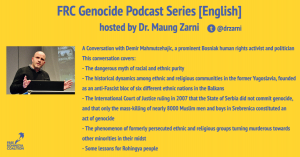
A conversation with Demir Mahmutcehajic, a prominent Bosniak human rights activist

Son of a Croatian mother and Muslim Bosnian (or Bosniak) father, A conversation with Demir Mahmutcehajic, a prominent Bosniak human rights activist Demir Mahmutcehajic (44) is a prominent Bosniak (or Muslim Bosnian) human rights activist and politician based in the old town of Stolac, Bosnia and Herzegovina. As a teenager in 1992, he and his family fled hthe Serbian-controlled Bosnia to his mother’s Croatian hometown named Vela Luka. From Croatia they had to leave in a year for safety first in Kuwait and subsequently to Slovenia when Croatian troops began their attacks on Bosnia and Herzegovina. After drifting as a
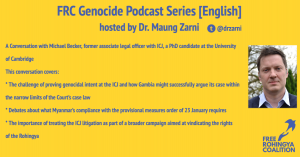
A Conversation with Michael Becker, former associate legal officer with ICJ, a PhD candidate at the University of Cambridge

This conversation covers: • The challenge of proving genocidal intent at the ICJ and how Gambia might successfully argue its case within the narrow limits of the Court’s case law   • Debates about what Myanmar’s compliance with the provisional measures order of 23 January requires • The importance of treating the ICJ litigation as part of a broader campaign aimed at vindicating the rights of the Rohingya Former ICJ Associate Legal Officer  and PhD scholar at Cambridge U. Michael A. Becker shared his expert views on the various aspects of The Gambia vs Myanmar case at the ICJ, driving home his

Sign Petition: Bangladesh Must End Internet Ban in Rohingya Refugee Camps

To: Government of Bangladesh Bangladesh Must End Internet Ban in Rohingya Refugee Camps Petition Text The government of Bangladesh MUST lift the internet ban in the 35 Rohingya refugee camps in Cox’s Bazar, where internet access has been shut down since September 2019 Why is this important? The Rohingya have suffered decades of systematic persecution in their home country of Myanmar. They have been denied citizenship, freedom of movement, access to education and health services. They have been subject to land confiscations, arbitrary arrests, forced labour, extortion, torture, rape, mass killings, the destruction of whole villages and other forms of collective

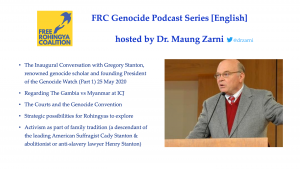
The Inaugural Conversation with Gregory Stanton, renowned genocide scholar

On 23 May Myanmar filed its first report to the International Court of Justice with regards to its compliance with the ICJ-ordered “provisional measures” on the allegations of Myanmar genocide against Rohingyas. The court declared Muslim ethnic Rohingyas “a protected group” under the Genocide Convention. In this inaugural interview on the Free Rohingya Coalition Genocide Podcast Series, the world renowned genocide scholar and founding President of the Genocide Watch Gregory Stanton spoke to Dr Maung Zarni on a range of topics including The Gambia vs Myanmar case at the ICJ, the likely outcome of this international justice process, the record

Free Rohingya Coalition (FRC) Statement calling on governments of ASEAN and South Asia to urgently provide entry and refuge to Rohingya Survivors of Myanmar’s Genocide and tackle the rising hate-speech occurring within their territories

IMMEDIATE RELEASE28 April 2020 Free Rohingya Coalition (FRC) Statement calling on governments of ASEAN and South Asia to urgently provide entry and refuge to Rohingya Survivors of Myanmar’s Genocide and tackle the rising hate-speech occurring within their territories Frankfurt, Germany and Cox’s Bazar, Bangladesh:   The Free Rohingya Coalition, a global network of Rohingya survivors and international activists working to end Myanmar’s on-going genocide, are deeply troubled by the news reports about a number of Asian states, pushing starving Rohingyas on boats back out to the dangerous waters. Specifically, Malaysia, Thailand and Bangladesh are reportedly refusing to allow boat-loads of Rohingya

Visiting Auschwitz the day Poland locked itself down

By Maung Zarni | Published by Anadolu Agency on March 30, 2020 Genocides start with an act of framing human community, with their distinct group identity, typically vulnerable and weak, as ‘a virus’ or ‘existential threat’ LONDON — The SS, Hitler’s ruthless deliverers of death, came to believe their own racially-charged propaganda about diseases being spread by Jews in Nazi-occupied Europe. They succumbed to their own fears of viruses and other contagions. So much so, that during the deportations of Jews from the ghetto to the camps, the SS troops in Krakow would not enter the Jewish ghetto hospital set up

ROHINGYA IN KSA: What will the Kingdom gain from deporting them?

By Nay San Lwin | Published by The Daily Star on March 5, 2020 If you look at the major cities around the world, from New York to London, you will find the Rohingya are there. You can be sure that wherever they are, be it in Riyadh or Vancouver, they have gone by one of three routes—seeking asylum, UN agency resettlement or entry with a counterfeit passport from a third country. And so it is, that an estimated 42,000 Rohingya are in Saudi Arabia. Worryingly, they face deportation to Bangladesh. The situation has arisen because in the last four

Free Rohingya Coalition Call for an independent review of BBC World Service Burmese Language Programme

Date: February 25, 2020 IMMEDIATE RELEASE Free Rohingya Coalition Call for an independent review of BBC World Service Burmese Language Programme The World Service must not be permitted to amplify, legitimize and put more fuel on the popular flame of anti-Rohingya racism London and Frankfurt:  The role of the Burmese language media and social media in condoning and disseminating racial hatred against the Rohingya in Myanmar is increasingly under the international spot light, particularly in light of the cases relating to mass atrocities  at the International Court of Justice and the International Criminal Court in The Hague (https://www.icj-cij.org/files/case-related/178/178-20200123-PRE-01-00-EN.pdf). Journalists who

What does the Myanmar Provisional Measures Order by the International Court of Justice mean for ASEAN?

By Maung Zarni | Published by FORSEA on February 12, 2020 It is long overdue for ASEAN to sync its policies towards Myanmar with international opinion, legal and human rights, and the global public. On January 23, 2020, the International Court of Justice, the UN’s highest judicial authority which handles legal disputes among the member states, announced its decision to proceed with The Gambia vs Myanmar and issued the provisional measures aimed at preventing (further) genocidal acts against Myanmar’s Rohingya people and at protecting the evidence of the past atrocities which Myanmar troops committed against the ethnic minority community in