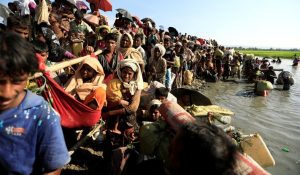
By Ahmet Gurhan Kartal | Published by Anadolu Agency on August 29, 2018 Buddhist activist Maung Zarni denounces atrocities targeting Rohingya in his country LONDON — The atrocities targeting Myanmar’s Rohingya minority are similar to those committed by Nazi Germany, according to a prominent Buddhist human rights activist. Speaking to Anadolu Agency in Kent, the UK, Maung Zarni, a coordinator at the Free Rohingya Coalition, said the international community should act against his country of origin. Zarni’s remarks come after the UN released a report earlier this week documenting mass gang rapes, killings — including of infants and
Select published works on Myanmar GENOCIDE since 2013 by ZARNI, Natalie Brinham and Amartya Sen

Buddhist Nationalism in Burma Institutionalized racism against the Rohingya Muslims led Burma to genocide By Maung Zarni SPRING 2013 Rohingya are categorically darker-skinned people—sometimes called by the slur “Bengali kalar.” Indeed, the lighter-skinned Buddhists of Burma are not alone in their fear of dark-skinned people and belief that the paler the skin, the more desirable, respectable, and protected one is. Read more: https://tricycle.org/magazine/buddhist-nationalism-burma/ — The Slow-Burning Genocide of Myanmar’s Rohingya By Zarni, Maung; Cowley, Alice Since 2012, the Rohingya have been subject to renewed waves of hate campaigns and accompanying violence, killings and ostracization that aim both to destroy the Rohingya and to permanently
Published stories on the Rohingya Genocide Remembrance Day by Anadolu Agency

Links of the published stories on the Rohingya Remembrance Day [22 – 28 Aug. 2018] by Anadolu Agency Rohingya returnees tortured by Myanmar police: HRW Turkey at forefront of giving aid to Rohingya refugees Turkish group distributes meat to Rohingya in Myanmar UN complains of impeded access into Myanmar’s Rakhine Rohingya in Bangladesh pray to return home during Eid Myanmar deprives Rohingya of their identity Security remains ‘major’ concern for Rohingya: NGO head UNICEF urges to invest in Rohingya children’s education Turkish facility treats nearly 100,000 Rohingya refugees Canada to host Rohingya genocide remembrance events Rohingya mourn first anniversary of Rakhine
Rohingyas declare Aug 25 as ‘genocide day’

By Abdul Aziz | Published by Dhaka Tribune on August 27, 2018 The UN likened the Aug 25 crackdown in the Rakhine state to genocide The Rohingyas have announced to observe August 25 as the “genocide day,” a year after a Myanmar military crackdown forced more than 700,000 members of the ethnic minority to flee the Rakhine state. The announcement came from protest rallies by the Rohingyas at Ukhiya and Teknaf on Saturday. A group calling itself the “Free Rohingya Coalition” has been campaigning to highlight the last several days of the barbarity and atrocity of the August 25, 2017
Five Layers of Systemic Injustices Rohingyas have long suffered

Five Layers of Systemic Injustices Rohingyas have long suffered By Maung Zarni August 27, 2018 1) Myanmar gives annihiliators internal blanket impunity Myanmar perpetrators inside Myanmar enjoy blanket impunity in destroying Rohingya people, literally, psychologically, intellectually, culturally, and from their social and physical foundations of life; 2) Myanmar enjoys blanket impunity within the UN System Myanmar genocidal leaders like Senior General Min Aung Hlaing and Aung San Suu Kyi enjoy blanket international impunity, under variously distorted, twisted and pathetic narratives; 3) The Global Discourse of White Man’s (or Woman’s) as “Voices of Conscience and Humanity” usurp Rohingya voices, even when
Rohingya Voices

Rohingyas are pre-colonial indigenous people of Arakan or Western Myanmar, like any other groups including Bama or Myanmar, Kachin, Shan, etc.

“Myanmar lies that Rohingyas were not indigenous people of Arakan. This elderly man was Rohingya Indigenous Language Program newsreader on the country’s sole national broadcasting station – Burma Broadcasting Service – from 1961-1965”
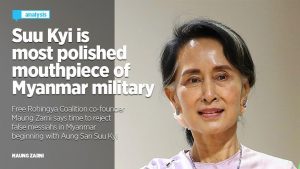
Suu Kyi is most polished mouthpiece of Myanmar military
Free Rohingya Coalition co-founder Maung Zarni says time to reject false messiahs in Myanmar beginning with Aung San Suu Kyi By Maung Zarni | Pubilshed by Anadolu Agency on August 25, 2018 LONDON — Watching YouTube Myanmar State Counsellor’s 43rd Singapore lecture — 1-hour lecture including the questions and answers – entitled, “Democratic Transition in Myanmar: Challenges and the Way Forward,” left me deeply disturbed, pained and outraged. The degree of her delusions, distortions and concoctions made me realize that my fellow Burmese dissident has become nothing more than the most polished mouth piece for her former captors, namely the murderous military regime. Aung
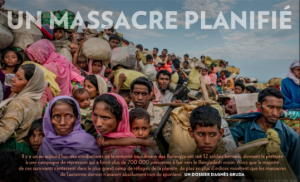
LA CRISE DES ROHINGYA, UN AN APRÈS UN MASSACRE PLANIFIÉ

Published by LA PRESSE on August 25, 2018 Il y a un an aujourd’hui, des combattants de la minorité musulmane des Rohingya ont tué 12 soldats birmans, donnant le prétexte à une campagne de répression qui a forcé plus de 700 000 personnes à fuir vers le Bangladesh voisin. Alors que la majorité de ces survivants s’entassent dans le plus grand camp de réfugiés de la planète, de plus en plus d’indices montrent que les massacres de l’automne dernier n’avaient absolument rien de spontané. UN DOSSIER D’AGNÈS GRUDA LA CRISE DES ROHINGYA, UN AN APRÈS « DES SIMILITUDES FRAPPANTES AVEC CE QUI S’ÉTAIT PASSÉ
Declaration of Solidarity with Rohingya and Call for Myanmar Government to be investigated by the ICC

Rohingya Genocide Day- 25th of August 2017. Declaration of Solidarity with Rohingya and Call for Myanmar Government to be investigated by the ICC By Mairead Maguire, Nobel Peace Laureate In February 2018 I participated in a Nobel Women’s Initiative delegation to Bangladesh. The purpose of our delegation was to visit Cox’s Bazar, Chittagong, Bangladesh where over 1 million Rohingya Muslim refugees were living in makeshift camps having fled persecution by Myanmar soldiers. On the delegation was Nobel Peace laureates Shirin Ebadi, Tawakkol Karmen and myself. We met with over 100 Rohingya women who told us their stories of rape and